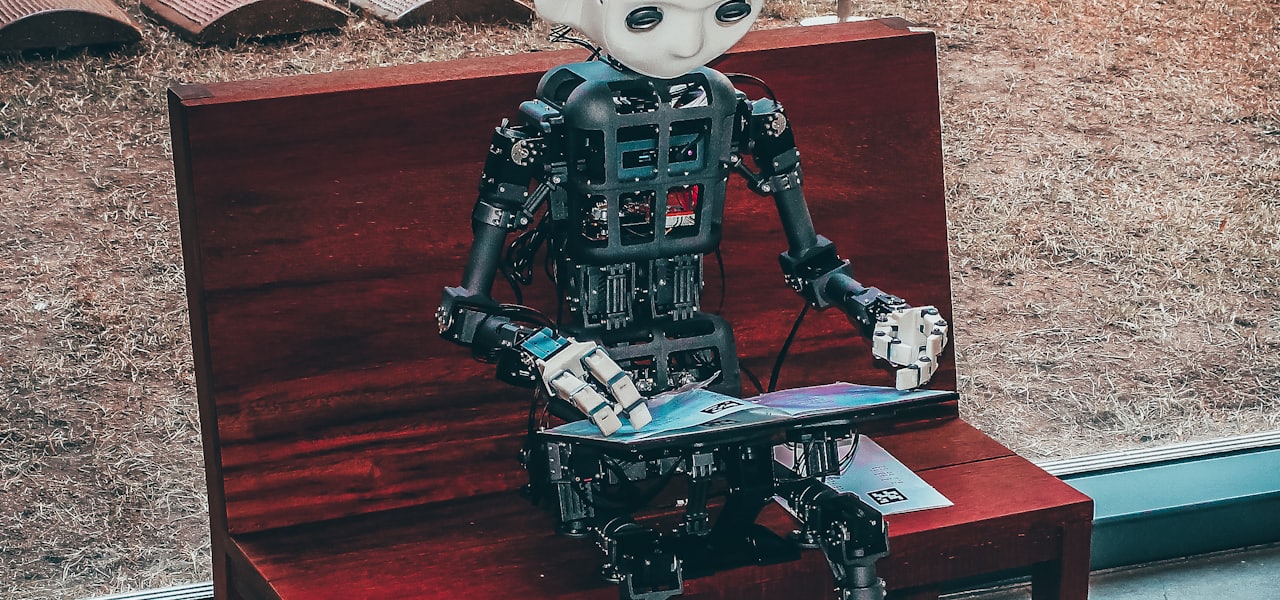
Artificial intelligence in education (often abbreviated as AIEd) is a subfield of educational technology that studies how to use artificial intelligence to create learning environments. Considerations in the field include data-driven decision-making, AI ethics, data privacy and AI literacy. Concerns include the potential for cheating, over-reliance, equity of access, reduced critical thinking, and the perpetuation of misinformation and bias. == History == Efforts to integrate AI into educational contexts have often followed technological advancement in the history of artificial intelligence. In the 1960s, educators and researchers began developing computer-based instruction systems, such as PLATO, developed by the University of Illinois. In the 1970s and 1980s, intelligent tutoring systems (ITS) were being adapted for classroom instruction. The International Artificial Intelligence in Education Society was founded in 1993. Coinciding with the AI boom of the 2020s, the use of large language models in the global north has been promoted and funded by venture capital and big tech. Companies creating AI services have targeted students and educational institutions as customers. Similarly, pre-AI boom educational companies have expanded their use of AI technologies. These commercial incentives for AIEd use may be related to a potential AI bubble. In the U.S., bipartisan support of AI development in K-12 education has been expressed, but specific implementations and best practices remain contentious. == Theory == AIEd applies theory from education studies, machine learning, and related fields. A 2019 review of the previous decade of studies found that most research prioritized technological design over pedagogical integration. Ouyang and Jiao (2021) propose three paradigms for AI in education, which follow roughly from least to most learner-centered and from requiring least to most technical complexity from the AI systems: AI-directed, learner-as-recipient: AIEd systems present a pre-set curriculum based on statistical patterns that do not adjust to learner's feedback. AI-supported, learner-as-collaborator: Systems that incorporate responsiveness to learner's feedback through, for example, natural language processing, wherein AI can support knowledge construction. AI-empowered, learner-as-leader: This model seeks to position AI as a supplement to human intelligence wherein learners take agency and AI provides consistent and actionable feedback. Some scholars place AI in education within a socio-technical framework. This positions AI alongside other emerging educational technologies, such as computing, the internet, and social media. The framework of Tsao, Heinrichs and Camit (2025) draws on new materialism and posthumanism, specifically Donna Haraway's concept of sympoiesis (making-with). This perspective views learning as an entanglement of human and non-human actors (students, teachers, and AI algorithms), where knowledge is co-composed in contact zones between human context and algorithmic prediction. AI agents have been trained on biased datasets, and thus continue to perpetuate societal biases. Since LLMs were created to produce human-like text, algorithmic bias can be introduced and reproduced. AI's data processing and monitoring reinforce neoliberal approaches to education rather than addressing inequalities. == Applications == Uses of generative AI chatbots in education have included assessment and feedback, machine translations, proof-reading exam question generation and copy editing, or as virtual assistants. Emotional AI in education is the study and development of systems that can detect learners' emotions or provide emotional support in learning. == Usage == === Schools and educators === Following the release of ChatGPT in November 2022, some schools and large school districts blocked access to the site and issued warnings that the use of such tools would be seen as cheating. Governmental and non-governmental organizations such as UNESCO, Article 4 of the European Union's AI Act, and the U.S. Department of Education have published reports advocating for specific AIEd approaches. National higher-education bodies have also published guidance on generative AI, including Ireland's Higher Education Authority, which issued a policy framework for higher education teaching and learning in December 2025. In 2024, UNESCO released updated global guidance for generative AI in education, emphasizing ethical use, teacher training, and data protection to ensure responsible integration of AI tools in learning environments. According to Taso (2025), policy implementation in higher education is interpreted and enacted differently by various organizations. These decentralized policies can lead to inconsistent enforcement and confusion among students regarding what constitutes acceptable use, with the burden of ethical navigation falling on individual teachers and students. AI integration in classrooms has created new forms of invisible labour for educators, who must navigate ambiguous policies, redesign assessments to be AI-resilient, and adjudicate potential academic integrity violations. The use of AI detection tools has also been criticised for creating an adversarial relationship between students and institutions, where students may be falsely accused of misconduct based on probabilistic software. AIEd advocates say that efforts should be made towards increasing global accessibility and training educators to serve underprivileged areas. === Students === Reliance on generative AI has been linked with reduced academic self-esteem and performance, and heightened learned helplessness. Algorithm errors and hallucinations are common flaws in AI agents, making them less trustworthy and reliable. According to a 2025 survey from Inside Higher Ed, 85% of higher education students use generative AI technology in some way, with 25% using AI to complete assignments for them. The most common reason cited for using AI to cheat was pressure to get high grades. 97% of students wanted some form of action from schools on the threat to academic integrity caused by AI, with the most popular options being clearer policies and more education about ethical uses of AI. In September 2025, The Atlantic published an op-ed from a high school senior arguing that the normalization of AI cheating was eroding critical thinking, academic integrity, creativity, and the shared student experience.
International Clinical Trials Registry Platform
The International Clinical Trials Registry Platform (ICTRP) is a platform for the registration of clinical trials operated by the World Health Organization. The ICTRP combines data from multiple cooperating clinical trials registries to generate a global view of clinical trials worldwide, with a search portal that allows access to the entire dataset. It requires a minimum standard set of database fields, the WHO Trial Registration Data Set, to be present for a trial to be registered. All entries are given a Universal Trial Number (UTN) that identifies them uniquely. The organization has sought to assist various national governments in establishing their own clinical trials databases. It combines data from the following primary registries and data providers: Australian New Zealand Clinical Trials Registry (ANZCTR) Brazilian Clinical Trials Registry (ReBec) Chinese Clinical Trial Registry (ChiCTR) Clinical Research Information Service (CRiS), Republic of Korea ClinicalTrials.gov Clinical Trials Information System (CTIS), European Medicines Agency Clinical Trials Registry - India (CTRI) Cuban Public Registry of Clinical Trials (RPCEC) EU Clinical Trials Register (EU-CTR) German Clinical Trials Register (DRKS) Iranian Registry of Clinical Trials (IRCT) ISRCTN (UK) International Traditional Medicine Clinical Trial Registry (ITMCTR) Japan Registry of Clinical Trials (jRCT) Japan Primary Registries Network (JPRN) Lebanese Clinical Trials Registry (LBCTR) Overview of Medical Research in the Netherlands (OMON) Thai Clinical Trials Registry (TCTR) Pan African Clinical Trial Registry (PACTR) Peruvian Clinical Trial Registry (REPEC) Sri Lanka Clinical Trials Registry (SLCTR)
Lisp machine
Lisp machines are general-purpose computers designed to efficiently run Lisp as their main software and programming language, usually via hardware support. They are an example of a high-level language computer architecture. In a sense, they were the first commercial single-user workstations. Despite being modest in number (perhaps 7,000 units total as of 1988) Lisp machines commercially pioneered some now-commonplace technologies, including networking innovations such as Chaosnet, and effective garbage collection. Several firms built and sold Lisp machines in the 1980s: Symbolics (3600, 3640, XL1200, MacIvory, and other models), Lisp Machines Incorporated (LMI Lambda), Texas Instruments (Explorer, MicroExplorer), and Xerox (Interlisp-D workstations). The operating systems were written in Lisp Machine Lisp, Interlisp (Xerox), and later partly in Common Lisp. == History == === Historical context === Artificial intelligence (AI) computer programs of the 1960s and 1970s intrinsically required what was then considered a huge amount of computer power, as measured in processor time and memory space. The power requirements of AI research were exacerbated by the Lisp symbolic programming language, when commercial hardware was designed and optimized for assembly- and Fortran-like programming languages. At first, the cost of such computer hardware meant that it had to be shared among many users. As integrated circuit technology shrank the size and cost of computers in the 1960s and early 1970s, and the memory needs of AI programs began to exceed the address space of the most common research computer, the Digital Equipment Corporation (DEC) PDP-10, researchers considered a new approach: a computer designed specifically to develop and run large artificial intelligence programs, and tailored to the semantics of the Lisp language. To provide consistent performance for interactive programs, these machines would often not be shared, but would be dedicated to a single user at a time. === Initial development === In 1973, Richard Greenblatt and Thomas Knight, programmers at Massachusetts Institute of Technology (MIT) Artificial Intelligence Laboratory (AI Lab), began what would become the MIT Lisp Machine Project when they first began building a computer hardwired to run certain basic Lisp operations, rather than run them in software, in a 24-bit tagged architecture. The machine also did incremental (or Arena) garbage collection. More specifically, since Lisp variables are typed at runtime rather than compile time, a simple addition of two variables could take five times as long on conventional hardware, due to test and branch instructions. Lisp Machines ran the tests in parallel with the more conventional single instruction additions. If the simultaneous tests failed, then the result was discarded and recomputed; this meant in many cases a speed increase by several factors. This simultaneous checking approach was used as well in testing the bounds of arrays when referenced, and other memory management necessities (not merely garbage collection or arrays). Type checking was further improved and automated when the conventional byte word of 32 bits was lengthened to 36 bits for Symbolics 3600-model Lisp machines and eventually to 40 bits or more (usually, the excess bits not accounted for by the following were used for error-correcting codes). The first group of extra bits were used to hold type data, making the machine a tagged architecture, and the remaining bits were used to implement compressed data representation (CDR) coding (wherein the usual linked list elements are compressed to occupy roughly half the space), aiding garbage collection by reportedly an order of magnitude. A further improvement was two microcode instructions which specifically supported Lisp functions, reducing the cost of calling a function to as little as 20 clock cycles, in some Symbolics implementations. The first machine was called the CONS machine (named after the list construction operator cons in Lisp). Often it was affectionately referred to as the Knight machine, perhaps since Knight wrote his master's thesis on the subject; it was extremely well received. It was subsequently improved into a version called CADR (a pun; in Lisp, the cadr function, which returns the second item of a list, is pronounced /ˈkeɪ.dəɹ/ or /ˈkɑ.dəɹ/, as some pronounce the word "cadre") which was based on essentially the same architecture. About 25 of what were essentially prototype CADRs were sold within and without MIT for ~$50,000; it quickly became the favorite machine for hacking – many of the most favored software tools were quickly ported to it (e.g. Emacs was ported from ITS in 1975). It was so well received at an AI conference held at MIT in 1978 that Defense Advanced Research Projects Agency (DARPA) began funding its development. === Commercializing MIT Lisp machine technology === In 1979, Russell Noftsker, being convinced that Lisp machines had a bright commercial future due to the strength of the Lisp language and the enabling factor of hardware acceleration, proposed to Greenblatt that they commercialize the technology. In a counter-intuitive move for an AI Lab hacker, Greenblatt acquiesced, hoping perhaps that he could recreate the informal and productive atmosphere of the Lab in a real business. These ideas and goals were considerably different from those of Noftsker. The two negotiated at length, but neither would compromise. As the proposed firm could succeed only with the full and undivided assistance of the AI Lab hackers as a group, Noftsker and Greenblatt decided that the fate of the enterprise was up to them, and so the choice should be left to the hackers. The ensuing discussions of the choice divided the lab into two factions. In February 1979, matters came to a head. The hackers sided with Noftsker, believing that a commercial venture-fund-backed firm had a better chance of surviving and commercializing Lisp machines than Greenblatt's proposed self-sustaining start-up. Greenblatt lost the battle. It was at this juncture that Symbolics, Noftsker's enterprise, slowly came together. While Noftsker was paying his staff a salary, he had no building or any equipment for the hackers to work on. He bargained with Patrick Winston that, in exchange for allowing Symbolics' staff to keep working out of MIT, Symbolics would let MIT use internally and freely all the software Symbolics developed. A consultant from CDC, who was trying to put together a natural language computer application with a group of West-coast programmers, came to Greenblatt, seeking a Lisp machine for his group to work with, about eight months after the disastrous conference with Noftsker. Greenblatt had decided to start his own rival Lisp machine firm, but he had done nothing. The consultant, Alexander Jacobson, decided that the only way Greenblatt was going to start the firm and build the Lisp machines that Jacobson desperately needed was if Jacobson pushed and otherwise helped Greenblatt launch the firm. Jacobson pulled together business plans, a board, a partner for Greenblatt (one F. Stephen Wyle). The newfound firm was named LISP Machine, Inc. (LMI), and was funded by CDC orders, via Jacobson. Around this time Symbolics (Noftsker's firm) began operating. It had been hindered by Noftsker's promise to give Greenblatt a year's head start, and by severe delays in procuring venture capital. Symbolics still had the major advantage that while 3 or 4 of the AI Lab hackers had gone to work for Greenblatt, 14 other hackers had signed onto Symbolics. Two AI Lab people were not hired by either: Richard Stallman and Marvin Minsky. Stallman, however, blamed Symbolics for the decline of the hacker community that had centered around the AI lab. For two years, from 1982 to the end of 1983, Stallman worked by himself to clone the output of the Symbolics programmers, with the aim of preventing them from gaining a monopoly on the lab's computers. Regardless, after a series of internal battles, Symbolics did get off the ground in 1980/1981, selling the CADR as the LM-2, while Lisp Machines, Inc. sold it as the LMI-CADR. Symbolics did not intend to produce many LM-2s, since the 3600 family of Lisp machines was supposed to ship quickly, but the 3600s were repeatedly delayed, and Symbolics ended up producing ~100 LM-2s, each of which sold for $70,000. Both firms developed second-generation products based on the CADR: the Symbolics 3600 and the LMI-LAMBDA (of which LMI managed to sell ~200). The 3600, which shipped a year late, expanded on the CADR by widening the machine word to 36-bits, expanding the address space to 28-bits, and adding hardware to accelerate certain common functions that were implemented in microcode on the CADR. The LMI-LAMBDA, which came out a year after the 3600, in 1983, was compatible with the CADR (it could run CADR microcode), but hardware differences existed. Texas Instruments (TI) joined the fray whe
Oracle Database
Oracle AI Database (commonly referred to as Oracle Database, Oracle DBMS, Oracle Autonomous Database, or simply as Oracle) is a proprietary multi-model database management system produced and marketed by Oracle Corporation. It is a database commonly used for running online transaction processing (OLTP), data warehousing (DW) and mixed (OLTP & DW) database workloads. Oracle AI Database uses SQL for database updating and retrieval. Oracle Database runs on-premises, on Oracle engineered systems such as Oracle Exadata, on Oracle Cloud Infrastructure, and as a managed Autonomous Database service. It is also offered inside Microsoft Azure, Google Cloud, and Amazon Web Services data centers through Oracle's multicloud offerings. The current long-term support release, Oracle AI Database 26ai, became available in the cloud and on Oracle engineered systems in October 2025 and on-premises for Linux x86-64 in January 2026. == History == Larry Ellison and his two friends and former co-workers, Bob Miner and Ed Oates, started a consultancy called Software Development Laboratories (SDL) in 1977, later Oracle Corporation. SDL developed the original version of the Oracle software. The name Oracle comes from the code-name of a Central Intelligence Agency-funded project Ellison had worked on while formerly employed by Ampex; the CIA was Oracle's first customer, and allowed the company to use the code name for the new product. Ellison wanted his database to be compatible with IBM System R, but that company's Don Chamberlin declined to release its error codes. By 1985 Oracle advertised, however, that "Programs written for SQL/DS or DB2 will run unmodified" on the many non-IBM mainframes, minicomputers, and microcomputers its database supported "Because all versions of ORACLE are identical". Later releases introduced capabilities associated with successive eras of the product, including PL/SQL stored procedures and triggers in Oracle7 (1992), Real Application Clusters in Oracle9i (2001), grid infrastructure and automatic management in Oracle 10g (2003), the multitenant architecture and In-Memory Column Store in Oracle Database 12c (2013), and AI Vector Search and JSON Relational Duality in Oracle Database 23ai (2024). In October 2025 Oracle rebranded the 23ai line as Oracle AI Database 26ai. (see Release History) == Architecture == An Oracle Database system consists of an instance and a database. The instance is a set of memory structures and background processes; the database is the set of files that store data. The instance exists only in memory, and a single instance is associated with one multitenant container database. The principal memory structures are the System Global Area, which is shared, and the Program Global Areas, which are private to individual processes. The shared pool, database buffer cache, and redo log buffer are components of the System Global Area, and the optional In-Memory Column Store also resides there. Background processes operate on the database files and use these memory structures; they include the database writer, the log writer, the checkpoint process, and the system and process monitor processes. Server processes handle connections from client programs and run their SQL statements. Storage is organized logically and physically. Logically, data is held in tablespaces composed of segments, extents, and data blocks. Physically, the database comprises datafiles, control files, and online redo log files, with archived redo logs supporting media recovery. == High Availability and Scalability == Oracle Database includes several technologies for high availability, disaster recovery, and scale. Oracle Real Application Clusters allows multiple instances on separate servers to access one shared database concurrently; it was introduced with Oracle9i in 2001. Oracle Data Guard maintains standby databases synchronized with a primary database, and Active Data Guard additionally allows read-only workloads on a standby while it applies changes. Oracle GoldenGate performs logical replication and data integration across heterogeneous systems. Native sharding, introduced in Oracle Database 12c Release 2, distributes one logical database across independent shards. Oracle Exadata is an engineered system that pairs database servers with storage servers and offloads operations such as filtering to the storage tier; it is available on-premises, in Oracle Cloud Infrastructure, and through Cloud@Customer. == Notable Features == AI Vector Search adds a vector data type, vector indexes, and vector distance operators to the database. These allow similarity search over machine-learning embeddings to be expressed in SQL and combined with queries over relational, JSON, spatial, and graph data. It became generally available in Oracle Database 23ai. JSON Relational Duality exposes the same data both as relational tables and as JSON documents through duality views, so that an application can read and write either representation of the data. It became generally available in Oracle Database 23ai. In-Memory Column Store maintains a column-oriented copy of selected tables in memory in addition to the row-oriented format, and the optimizer can use the columnar copy for analytic queries. It was introduced in Oracle Database 12c Release 1.Partitioning divides large tables and indexes into independently managed pieces. Advanced Compression and Hybrid Columnar Compression are compression features for transactional and warehouse data respectively. == Data Types == Oracle AI Database supports a variety of data types and data models within a single system. These include traditional relational data types as well as semi-structured, unstructured, and specialized data formats, enabling different types of data to be stored and queried together. == Releases and versions == Oracle products follow a custom release-numbering and -naming convention. The "ai" in the current release, Oracle AI Database 26ai, stands for "Artificial Intelligence". Previous releases (e.g. Oracle Database 19c, 10g, and Oracle9i Database) have used suffixes of "c", "g", and "i" which stand for "Cloud", "Grid", and "Internet" respectively. Prior to the release of Oracle8i Database, no suffixes featured in Oracle AI Database naming conventions. There was no v1 of Oracle AI Database, as Ellison "knew no one would want to buy version 1". For some database releases, Oracle also provides an Express Edition (XE) that is free to use. Oracle AI Database release numbering has used the following codes: The Introduction to Oracle AI Database includes a brief history on some of the key innovations introduced with each major release of Oracle AI Database. See My Oracle Support (MOS) note Release Schedule of Current Database Releases (Doc ID 742060.1) for the current Oracle AI Database releases and their patching end dates. == Patch updates and security alerts == Prior to Oracle Database 18c, Oracle Corporation released Critical Patch Updates (CPUs) and Security Patch Updates (SPUs) and Security Alerts to close security vulnerabilities. These releases are issued quarterly; some of these releases have updates issued prior to the next quarterly release. Starting with Oracle Database 18c, Oracle Corporation releases Release Updates (RUs) and Release Update Revisions (RURs). RUs usually contain security, regression (bug), optimizer, and functional fixes which may include feature extensions as well. RURs include all fixes from their corresponding RU but only add new security and regression fixes. However, no new optimizer or functional fixes are included. == Competition == In the market for relational databases, Oracle AI Database competes against commercial products such as IBM Db2 and Microsoft SQL Server. Oracle and IBM tend to battle for the mid-range database market on Unix and Linux platforms, while Microsoft dominates the mid-range database market on Microsoft Windows platforms. However, since they share many of the same customers, Oracle and IBM tend to support each other's products in many middleware and application categories (for example: WebSphere, PeopleSoft, and Siebel Systems CRM), and IBM's hardware divisions work closely with Oracle on performance-optimizing server-technologies (for example, Linux on IBM Z). Niche commercial competitors include Teradata (in data warehousing and business intelligence), Software AG's ADABAS, Sybase, and IBM's Informix, among many others. In the cloud, Oracle AI Database competes against the database services of AWS, Microsoft Azure, and Google Cloud Platform. Increasingly, the Oracle AI Database products compete against open-source software relational and non-relational database systems such as PostgreSQL, MongoDB, Couchbase, Neo4j, ArangoDB and others. Oracle acquired Innobase, supplier of the InnoDB codebase to MySQL, in part to compete better against open source alternatives, and acquired Sun Microsystems, owner of MySQL, in 2010. Database products licensed as open
Interactive activation and competition networks
Interactive activation and competition (IAC) networks are artificial neural networks used to model memory and intuitive generalizations. They are made up of nodes or artificial neurons which are arrayed and activated in ways that emulate the behaviors of human memory. The IAC model is used by the parallel distributed processing (PDP) Group and is associated with James L. McClelland and David E. Rumelhart; it is described in detail in their book Explorations in Parallel Distributed Processing: A Handbook of Models, Programs, and Exercises. This model does not contradict any currently known biological data or theories, and its performance is close enough to human performance as to warrant further investigation.
Summify
Summify was a social news aggregator founded by Mircea Paşoi and Cristian Strat, two former Google and Microsoft interns from Romania. The service emailed its users a periodic summary of news articles shared from their social networks based on their relevance and importance. The platform supported Twitter, Facebook, and Google Reader accounts. == History == In 2009, Paşoi and Strat created ReadFu, a plugin that provided a contextual summary and statistics of the target page of a hyperlink. In January 2010, ReadFu was accepted into the Vancouver-based start-up incubator Bootup Labs. On March 20, 2010 the service was renamed to Summify and a private beta began. On August 11, 2010 Paşoi and Strat announced a new direction for the service. It would become a real-time social news reader that aggregates incoming news from social networks and displays articles by importance using social reactions. After some feedback that the users preferred article digests by email more than the real-time news reader version, Summify discontinued the news reader version. In March 2011, Summify completed a Seed round, with investors including Rob Glaser, Accel Partners, and Stewart Butterfield. Summify received coverage from various news and media outlets such as TechCrunch. It was also featured in various news platforms, such as Time, The Globe and Mail, Mashable, VentureBeat, Gizmodo, Lifehacker, and The Next Web. Summify released a free app on the Apple App Store on July 8, 2011. The app allowed users to read their web summaries from iOS mobile devices. Summify was acquired by Twitter on January 19, 2012. The service shut down soon after, on June 22, 2012.
Production Rule Representation
The Production Rule Representation (PRR) is a proposed standard of the Object Management Group (OMG) that aims to define a vendor-neutral model for representing production rules within the Unified Modeling Language (UML), specifically for use in forward-chaining rule engines. == History == The OMG set up a Business Rules Working Group in 2002 as the first standards body to recognize the importance of the "Business Rules Approach". It issued 2 main RFPs in 2003 – a standard for modeling production rules (PRR), and a standard for modeling business rules as business documentation (BSBR, now SBVR). PRR was mostly defined by and for vendors of Business Rule Engines (BREs) (sometimes termed Business Rules Engine(s), like in Wikipedia). Contributors have included all the major BRE vendors, members of RuleML, and leading UML vendors. == Evolution == The PRR RFP originally suggested that PRR use a combination of UML OCL and Action Semantics for rule conditions and actions. However, expecting modellers to learn 2 relatively obscure UML languages in order to define a production rule proved unpalatable. Therefore, PRR OCL was defined that included OCL extensions for simple rule actions (as well as external functions). PRR OCL is currently considered "non-normative" i.e. is not part of the PRR standard per se. PRR beta applies just to a PRR Core that excludes an explicit expression language. The PRR RFP envisaged covering both forward and backward chaining rule engines. However, the lack of vendor support for / interest in backward chaining caused this to be revise to forward chaining and "sequential" semantics. The latter is simply the scripting mode provided by many BPM tools, where rules are listed and executed sequentially as if programmed. This provides PRR with better compatibility with typical BPM scripting engines (and acknowledges the fact that most BREs today support a "sequential" mode of operation, improving performance in some circumstances). == Status == PRR is currently at version 1.0.